Vegetative Architecture: The Stems and Root Cluster
Unlike the solitary trunk of commercial date palm orchards, Phoenix theophrasti exhibits an intensely cespitose (clustering) growth form. Individual mature clumps frequently contain three to eight secondary stems radiating from an expansive subterranean root plate. This underground mass serves as an anchoring reservoir amidst rocky torrent beds prone to violent flash-flooding during Cretan winter squalls.
Mature trunks reach typical heights of 10 to 12 meters, rarely reaching 15 meters in protected coastal river depressions. The trunk diameter averages 25 to 40 cm. The surface retains dense, rhomboid-shaped leaf scars arranged in tight spirals. As the trunk matures, the lower leaf bases weather away, revealing a tough, fibrous outer cortex capable of enduring fire scorch and saline sea spray.
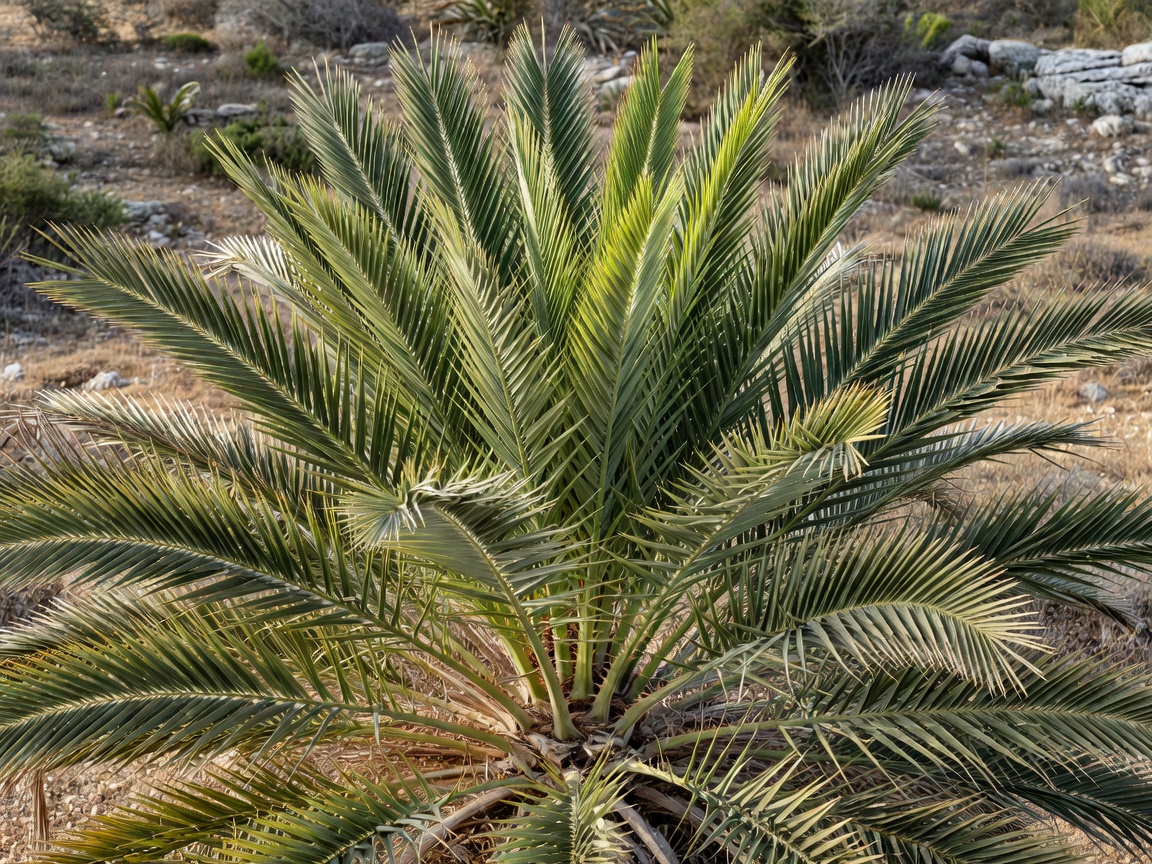
Foliar Morphology: Fronds and Pungent Thorns
The fronds (leaves) are pinnately compound, measuring between 2.2 and 3.2 meters long. The overall crown exhibits a strikingly erect, rigid silhouette, contrasting with the soft, arching crown of Phoenix canariensis or the drooping leaves of Phoenix dactylifera.
The foliage is conspicuously glaucous (greyish-blue to silver-green), covered with a thick cuticular wax layer that reduces evapotranspiration during the prolonged Aegean rainless period (May to October). The leaflets (pinnae) are arranged in multiple vertical planes along the rachis at narrow, acute angles.
Crucially, the basalmost leaflets are modified into formidable acanthophylls—sharp, lignified, yellowish-orange thorns up to 12 cm long. These form a protective perimeter around the apical bud, warding off browsing goats, wild sheep, and large herbivores that have historically inhabited the Mediterranean scrub.
Comparative Morphological Matrix
Botanists, agricultural researchers, and park rangers rely on specific biometric markers to distinguish wild P. theophrasti from feral and cultivated P. dactylifera:
| Trait | Phoenix theophrasti (Wild) | Phoenix dactylifera (Cultivated) |
|---|---|---|
| Growth Form | Vigorously suckering; dense multi-stem clusters | Often solitary or managed to single stems |
| Crown Orientation | Erect, compact, strictly upright fronds | Gracefully arching to pendulous at outer edges |
| Leaf Color | Silvery-glaucous grey-green with heavy wax | Muted blue-green to dusty olive |
| Basal Spines | Extremely rigid, pungent, 5–12 cm long | Moderate rigidity, typically 3–8 cm |
| Fruit Size | 12–16 mm long, 8–10 mm wide (small) | 25–70 mm long, 15–30 mm wide (large) |
| Mesocarp (Flesh) | Thin (1–2 mm), fibrous, dry, highly astringent | Thick, sugary, succulent, edible pulp |
| Endocarp (Seed) | Conspicuously grooved, stony, 10–13 mm | Deeply furrowed, cylindrical, 18–35 mm |
Reproductive Biology and Phenology
Phoenix theophrasti is strictly dioecious, meaning male (staminate) and female (pistillate) flowers are produced on completely separate individual palms. Inflorescences emerge in late April from boat-shaped woody spathes nestled deep inside the spiny frond crown.
Pollination is predominantly anemophilous (wind-driven), aided occasionally by generalist Mediterranean beetles and bees. By late summer, female spathes produce pendulous orange-brown fruit trusses containing up to several hundred small drupes. The fruits ripen between September and November. Due to their astringent and fibrous nature, the fruits are not dispersed by humans, but rather by winter stream floods and omnivorous native wildlife including beech martens (Martes foina bunites) and badgers (Meles meles arcalus).